
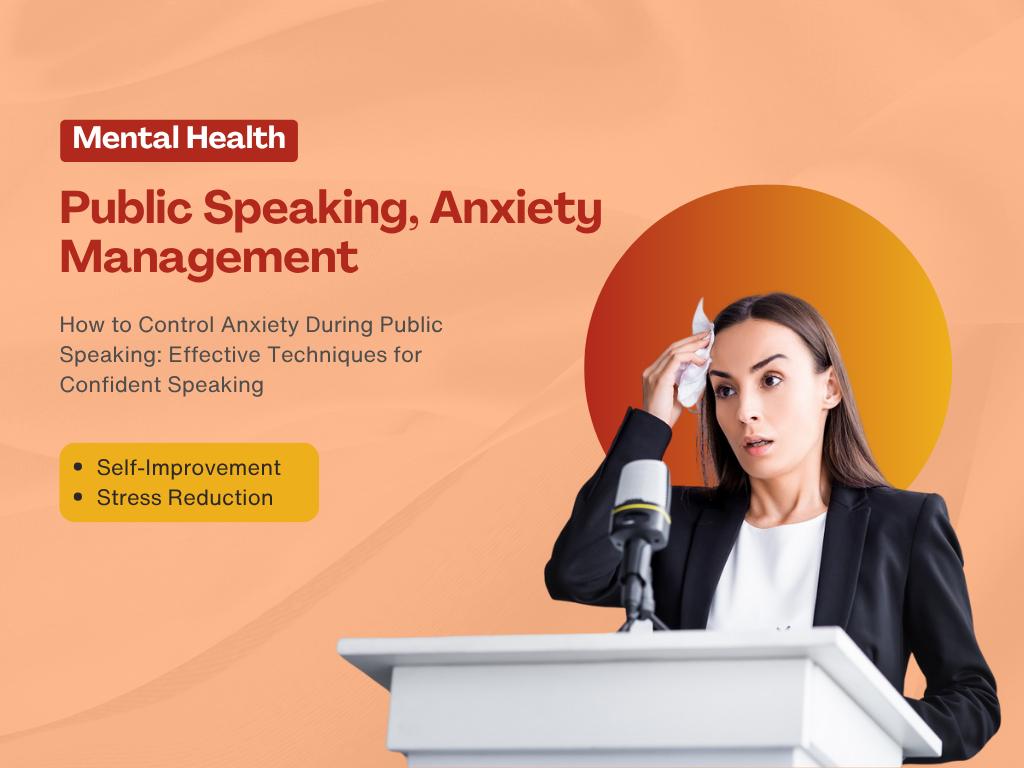

How to Manage Your Anxiety When Giving a Public Speech
One of the most frequent causes of anxiety is public speaking. Many people have trembling hands, a racing heart, or a fear of forgetting what they’re going to say when giving a presentation at work, a class lecture, or a family gathering. Even though this anxiety seems overwhelming, it is completely controllable with the correct techniques. The key to managing public speaking anxiety is to learn to cope with it, lessen its intensity, and channel it into confident communication rather than trying to totally eradicate it. The following techniques help you speak more clearly and confidently by combining psychological concepts, useful exercises, and long-term habits.
1. Recognize the Cause of Your Anxiety
Understanding the causes of anxiety is helpful before learning how to manage it. Speaking in front of an audience sets off a natural “fight or flight” reaction. Adrenaline and physical symptoms like sweating, shaking, or a fast heartbeat are triggered by the brain’s perception of being watched by others as a possible threat. The first step in controlling these reactions is realizing that they are common and normal. Experienced speakers still experience anxiety, so the objective is to manage it so that it doesn’t interfere with your message rather than completely eradicate it.
2. Be well-prepared, but avoid over-memorization
Confidence is boosted by preparation. You will expend less mental energy worrying about forgetting your material if you are more familiar with it. But learning every word by heart can be detrimental. If you depend on precise sentences, it can be frightening to forget even one. An improved strategy is:
- Make a solid outline with distinct sections.
- Instead of using complete sentences, focus on your main points.
- Just the beginning and conclusion should be committed to memory.
This allows you to sound natural while giving your speech structure. Since you’re not attempting to recite a script, you won’t be concerned about “messing up.”
3. Exercise in Practical Environments
Reading silently or practicing in your head won’t get you ready for speaking in public. Instead, try to replicate the real environment as much as you can. Get up, talk out loud, and picture a crowd. Practice with a small group of friends, record yourself, or use a mirror. Your mind is trained to view public speaking as comfortable rather than risky through repetition. If you have access to the actual location, spend some time there in advance to familiarize yourself with the layout, lighting, and acoustics. Fear is lessened by familiarity.
4. Calm Your Body with Breathing Techniques
Anxiety is very physical as well as psychological. Managing your body aids in managing your thoughts. There are two easy breathing methods that work particularly well:
(4–4–4–4) Box Breathing
Breathe in for four seconds, hold it for four, then release it for four.
Tension can be considerably reduced by repeating this for a minute.
Extended Exhalation Breathing
Inhale for four seconds, then exhale for six or eight.
The parasympathetic nervous system is triggered by a longer exhale, which tells your brain that you are safe.
Breathlessness and voice trembling can be significantly reduced by performing these exercises both before and during your speech.
5. Turn Your Fear Into Excitement
Reframing anxiety as excitement can lessen symptoms more successfully than attempting to “calm down,” according to research. Say to yourself, “I’m excited to share this,” rather than, “I’m nervous.” Changing your perspective makes your body work in your favor rather than against you because both emotions produce similar bodily sensations, such as elevated heart rate, increased alertness, and energy. Additionally, this mental reframing helps you focus on enthusiasm rather than fear, which makes your delivery sound more assured.
6. Pay Attention to Your Message, Not Yourself
Many people experience anxiety due to concerns about their appearance or whether they are being judged by the audience. Concentrate on the audience you are assisting and the message you are delivering rather than on yourself. Recall:
- The audience wants you to succeed; they are not your adversaries.
- The content piques the interest of the majority of listeners more than the speaker.
- Most of the time, even minor errors go unnoticed.
By concentrating on conveying something worthwhile, you transfer the burden from yourself to the objective of assisting others in comprehending your message.
7. Make Use of Strategic Pauses
During a speech, a quick pause can have a powerful effect. It allows you to take a deep breath, collect your thoughts, and keep your pace under control. A pause of two or three seconds may seem lengthy to you, but it seems natural to the audience. Additionally, pauses emphasize important points and improve clarity. When used purposefully, they can help you control your anxiety in the moment and make your speech sound more professional.
8. Include Modest, Regulated Motions
Excess adrenaline is produced by anxiety. That energy accumulates and exacerbates anxiety if you stay rigid. That energy can be released by making small movements, like stepping to one side, making hand gestures, or changing your posture. The secret is to move slowly and deliberately rather than quickly or impatiently. Additionally, a pen, note card, or clicker can help your hands feel less unsteady.
9. Begin with Tiny Audiences and Grow
One of the best long-term strategies to lessen fear is exposure therapy. Talk to one person at first, then a few friends, and finally somewhat larger groups. Increasing the audience size gradually aids in brain retraining. Every positive encounter creates a new memory that public speaking is doable and safe. The anxiety response naturally diminishes with time.
10. After Every Speech, Assess Yourself
You can get better for the next time by reflecting on yourself. Instead of concentrating on errors, consider:
- What went more smoothly than I anticipated?
- When did I feel most at ease?
- Which method was most beneficial?
- What tiny change can I make for the next time?
Making progress boosts self-assurance and lowers nervousness for upcoming speeches. The majority of people discover that their fear significantly lessens even after a few speaking attempts.
11. Recognize that flaws are common
Sometimes even the most skilled speakers falter. You might mispronounce a word, forget a sentence, or get lost. This is typical and doesn’t interfere with a presentation. Small mistakes are rarely remembered by the audience unless you highlight them. Instead of freaking out, pause, smile, and go on. Being confident is about maintaining composure when things don’t go as planned, not about being flawless.
In summary
Anyone can learn how to manage their anxiety when speaking in front of an audience. You can convert nervous energy into confident communication by comprehending the source of your fear, planning well, employing both physical and mental strategies, and practicing frequently. Recall that anxiety is a sign that you are concerned about your message, not an enemy. You can become composed, articulate, and persuasive whenever you stand in front of an audience with time and regular practice.


